THE platform, Third Eye Worldwide
An input for a blind person.
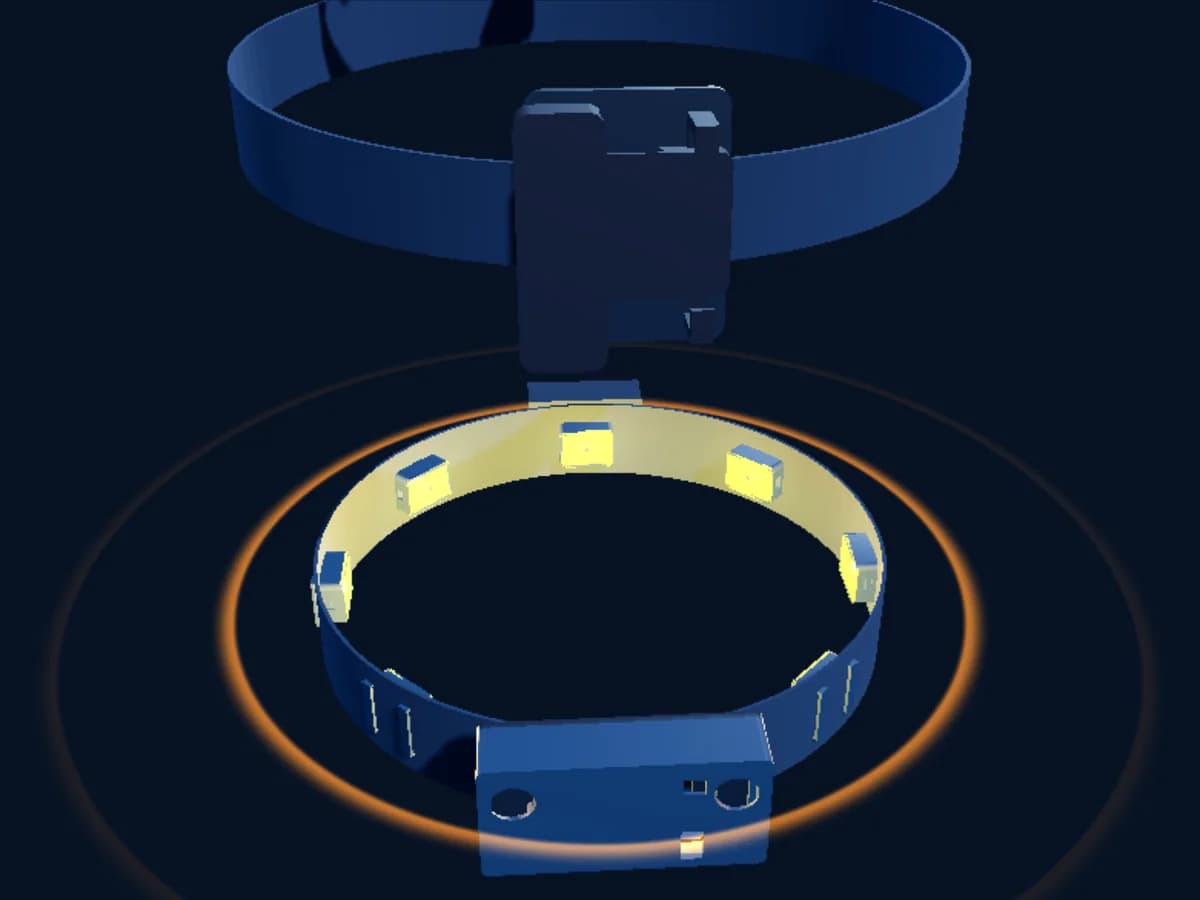
A joystick is a channel out of a person. The Third Eye Kit is a channel into one: small vibration motors on the skin that say what is where. In the street the kit's own sensors drive them. In the simulator, in a game, or in a virtual world, anything can. The same bands, the same grammar, the same frame on the wire. An assist frame for the legs is planned after the tests and is not part of this build.
The vision: practice in simulation, then live in reality.
TEK is a platform, not only a kit. It tells a person what is around them through touch. You learn it by playing in a simulated world, like a character moving through a game street, safely, before you ever wear it outside. Then you wear it in the real street, and the real world speaks the same language of touch you already learned.
Real now. The touch simulation runs on this site today: try the Simulation. The mapper below runs in your browser.
In development. The second generation kit, which the platform is built around.
Open to more, all planned
- A braille or refreshable display, for words the skin cannot carry. Planned.
- An input for the blind person, so the wearer can answer and ask, not only feel. Planned.
- Apps that speak the same frame: games, virtual places, learning a city before visiting it. Planned.
- Smart glasses as another sense feeding the same bands. Planned.
- Partners who build on the open design. Planned.
The idea
Three places, one language.
Fluency comes before the street. So the kit must work as well in a game as on a curb, and it must speak the same language in both.
Before the street, the simulation
The plan: nobody meets the street cold.
In the program's plan a blind or visually impaired person learns the kit in a simulation first, until the signals are fluent; at the milestones an orientation and mobility specialist walks beside the wearer from the first course (docs/15). On this site today that is the Simulation tab. Later it is built into the kit's own app, so the practice travels with the person. The Simulation on this site is the working prototype of that built-in practice.
Customizable, by design
The same bands carry a person's own tasks.
A simulation they run. A world-simulation game they learn a city in. A virtual place they explore before they visit it. The kit is customizable for all of it, and that is the proof of what it is. A joystick is an output from a person. This is an input for one.
The camera is your choice
Your phone on your chest, a separate camera, or none.
The camera feeds the app, never the warning path. If your phone has a camera, mount it on your chest and it does the looking, feeding the app on the phone. If you would rather keep your phone in your pocket, a low cost camera module on the mount can feed the Spine instead. If you have neither, the bands warn exactly the same, because the camera is never in the warning path. The choice is yours, so the kit stays affordable wherever it is built.
Voice is what assistive technology speaks today, and voice is a queue: one thing at a time, in order. Skin is a field: left and right, near and far, all at once, and it leaves the ears free for the street. The two belong together.
The frame on the wire
What the record fixes, and what the mapper adds.
Inside the kit, the Reflex sends the Spine one T.E.K.-Link 0.1 frame per control tick: twenty bytes, little endian, the team's own format and not a standard. The mapper above speaks the site's own JSON frame to the simulator and the game; it is a way to feel a mapping, not the wire the kit uses.
What is true today
The mapper runs. The board is next.
- The mapper produces the site's own JSON frames, and the simulator and the game speak them. The kit's wire format is T.E.K.-Link 0.1, the team's own format, not a standard.
- No band has read a frame from a phone, and none will in the street: nothing upstream writes into the warning path. A practice buzz stays on the phone's own motor.
- The hardware in the record comes from datasheets and working prices, not from a built board. The bench confirms or corrects them; every latency is modeled.
- In the street the belt, collar, and ankle bands speak only the three laws. Custom mappings live in games, virtual worlds, and apps.
- The assist frame drawn on the figures is planned after the tests. It is not built, not required, and not part of the second generation build; the frame on the wire here speaks to the bands only.