Research, Third Eye Worldwide
Everything here has a reason, and a research reason.
The Third Eye Kit presses the space around a blind or visually impaired person onto the skin. In the language of the field it is a non-invasive tactile sensory substitution interface: distance sensors feed a body worn array of small vibration motors, and the brain learns to use the pattern as a sense. Every reason on this page is read from the engineering record, file by file. Every number carries its status: modeled. An assist frame for the legs is planned after the tests and is not part of this build.
WhyWherever you see this, open it: the thing in plain words, the reason, and the way to the record file it comes from.
The research collaboration
The Third Eye Kit is developed by Third Eye Worldwide in collaboration with researchers at Columbia University's Computer Enabled Abilities Lab (CEAL).
The pieces, and why each one
Every part of the kit has a reason.
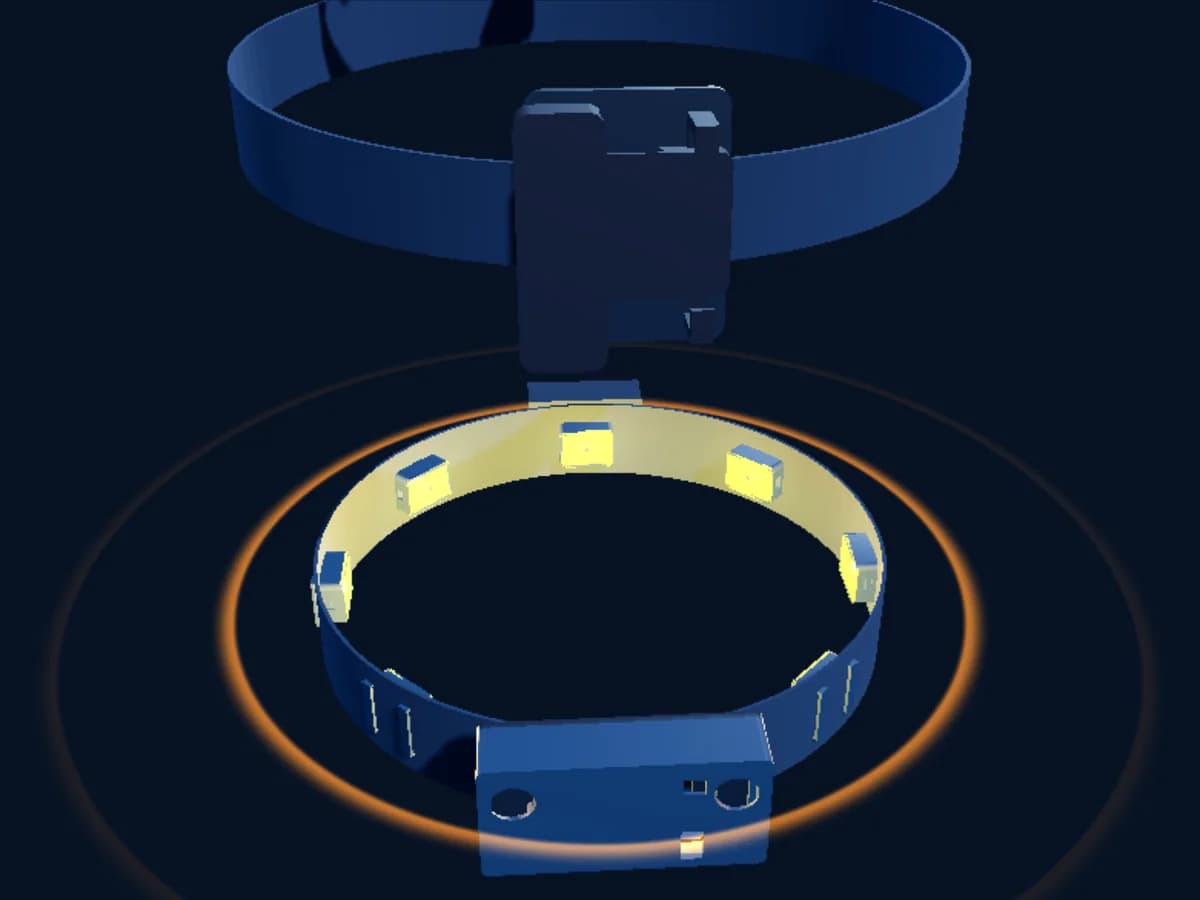
Press a part on the figure and read what it is, what it does, and where it sits. Each reason names the record file it comes from.
Belt selected
BELT
The belt
What it does
A waist belt with eight motors around it. Something at waist height on your left buzzes on your left.
What it is
Eight motors around the torso, at about 92 percent correct localization in the record's source.
Why it is there
Cholewiak, Brill and Schwab reported about 92 percent correct localization with eight tactors around the torso, near perfect at the navel and the spine, so the belt zones are anchored to those landmarks. Van Erp and colleagues showed a waist belt codes direction with no training.
Where it sits
Around the waist, anchored to the navel and the spine, sizes S to XL for a 70 to 130 cm waist.
The detailed research: docs/01, System overview and the three laws
The bands
Three bands, twenty motors, six signals.
The belt
A waist belt with eight motors around it. Something at waist height on your left buzzes on your left.
Where Around the waist, anchored to the navel and the spine, sizes S to XL for a 70 to 130 cm waist.
Why
In plain words
Eight motors around the torso, at about 92 percent correct localization in the record's source.
Because
Cholewiak, Brill and Schwab reported about 92 percent correct localization with eight tactors around the torso, near perfect at the navel and the spine, so the belt zones are anchored to those landmarks. Van Erp and colleagues showed a waist belt codes direction with no training.
The detailed research: docs/01, System overview and the three laws
The collar strip
Four motors on a strip at the collar. A buzz there means something at head height.
Where At the collar, over a base layer, one size with adjustment for a 32 to 45 cm neck.
Why
In plain words
One head channel, on the collar rather than the head itself.
Because
The first build speaks head height at the collar as one of its six signals: obstacle left, center, and right at the belt, head height at the collar, stairs up and stairs down at the ankles.
The detailed research: docs/01, System overview and the three laws
The ankle bands
Four motors on each ankle. A sweep upward means stairs up; a sweep downward means stairs down.
Where One band on each ankle, one size with a wide hook and loop range for a 20 to 28 cm ankle.
Why
In plain words
Four motors per readable stroke, so the skin reads the sweep as one movement.
Because
The placement sources set four motors per readable stroke, and the third law, if it moves, follow the motion, is carried by the ankles and nothing else in the first build.
The detailed research: docs/01, System overview and the three laws
The motors and their drivers
Coin actuators, one driver each, behind three multiplexers.
The motors
Coin linear resonant actuators, 10 mm across and about 3.5 mm tall, that hum at the lower edge of the band where the skin is most sensitive.
Where One in each motor pod, pressed on the skin through the band liner.
Why
In plain words
The skin's Pacinian channel is most sensitive from 200 to 300 Hz, and a coin LRA resonates at the lower edge of that band, 175 to 235 Hz.
Because
An eccentric rotating mass couples frequency to amplitude, so stronger also means a different pitch, which blurs the second law; it also rises and brakes slowly, which blurs the third. The reference part rises to rated amplitude in about 37 milliseconds and stops in about 35 to 50 with braking. Delivered acceleration through the liner, rise, and brake are measured at the bench first.
The motor drivers
One TI DRV2605L per motor, twenty in all, in closed loop LRA mode, eight channels to each of three multiplexers, twenty used.
Where In each motor pod beside its motor; the multiplexers in the belt pod and on the collar and ankle trunks.
Why
In plain words
The driver's address is fixed at 0x5A, so twenty of them cannot share one bus.
Because
TI's own reference board puts eight drivers behind a TCA9548A so they can be set up independently and played together. An amplitude write over I2C at 400 kHz takes well under a millisecond, so refreshing all twenty fits inside one control tick. A pod or a driver is a plug replaceable module.
The bands, the pods, the cable
Breathable elastic webbing with a soft liner, printed pods in PETG with skin safe TPU faces, and named cables and plugs for every link.
Where The belt and ankles on skin or over a thin base layer, the collar over a base layer; the cable in a fabric channel sewn to the inside of each band, away from the skin.
Why
In plain words
Textiles in prolonged skin contact meet OEKO-TEX STANDARD 100 Class II; skin contact plastics pass ISO 10993-5 and 10993-10.
Because
Generic flexible filament is not rated for prolonged skin contact, so the skin side face is a certified skin safe grade. Between bands the trunk passes through magnetic pogo pin breakaways, so a snagged band disconnects instead of dragging the wearer.
The sensor head
Four sensor families. Each owns a failure the others cannot cover.
The laser grids
Two time of flight grids. The forward one measures 4 by 4 points at 60 Hz with a full 8 by 8 frame every fourth cycle; the ground one, tilted down 35 degrees, reads 8 by 8 at 15 Hz for curbs and drop offs.
Where In the belt pod, looking out through its outward face.
Why
In plain words
The grid owns 5 to 60 cm, plus shape and drop offs beyond at lower confidence.
Because
It reaches 400 cm in the dark and about 285 cm in daylight over a 65 degree diagonal field, with a 940 nm Class 1 laser. Thin poles are caught by running 8 by 8 every fourth frame rather than adding a third sonar.
The detailed research: docs/04, Sensors and the fusion handoffs
The radar
A 24 GHz radar that tracks up to three moving targets to 8 m. It cannot see anything that stands still, by design.
Where In the belt pod, facing forward.
Why
In plain words
Radar owns movers only: people, bikes, carts.
Because
It depends on Doppler, so it cannot detect or range what is not moving. The wearer's own walking makes still things move relative to it, so it reports them while walking, and the IMU tells the firmware when the wearer has stopped and the radar is trusted less.
The detailed research: docs/04, Sensors and the fusion handoffs
The sonar
Two waterproof 40 kHz transducers, turned about 20 degrees outward, reading about 25 cm to 450 cm.
Where In the belt pod, set back so the blind zone sits inside the belt line.
Why
In plain words
Sonar owns glass and large surfaces from 25 cm to 4 m.
Because
Sound is insensitive to glass transparency, so an angled glass door returns at least one echo to one of the two beams. The disagreement rule follows: when the grid sees nothing and the sonar sees a surface, buzz. A false buzz costs a step; a missed glass door costs a face.
The detailed research: docs/04, Sensors and the fusion handoffs
The IMU
A nine axis inertial unit with on chip fusion, reading the wearer's rotation up to 400 times a second.
Where In the belt pod.
Why
In plain words
It milestones the radar and detects gait.
Because
When the wearer has stopped, the radar is trusted less; when the wearer runs, a running mode raises the ground grid's priority, pauses scene description, and runs only the reflex belt. Running is not claimed until the test plan requires and verify it.
The detailed research: docs/04, Sensors and the fusion handoffs
The core
The Reflex, the Spine, and the pack.
The Reflex
An RP2350, the Raspberry Pi Pico 2 class board, running one hard real time loop: sensors in, twenty motor commands out, every tick.
Where In the belt pod.
Why
In plain words
Two Cortex-M33 cores at 150 MHz with hardware float, 520 kB of SRAM, signed boot, and a hardware watchdog, at the price of the RP2040.
Because
The per column fusion and drop off detection run in hardware float; the buffers for two grids and the radar tracks fit in SRAM; signed boot protects the safety firmware. Two I2C buses, so a stuck actuator write can never delay a sensor read. The Reflex has no data dependency on the Spine or the phone: it only transmits.
The Spine
An ESP32-S3 that logs and talks to the phone over Bluetooth LE, fed by the Reflex over a one way wire.
Where In the belt pod, across the isolation boundary from the Reflex.
Why
In plain words
Nothing upstream can write into the warning path.
Because
The Reflex sends a twenty byte T.E.K.-Link 0.1 frame per tick, Reflex TX to Spine RX, with no wire back. The phone link adds tens of milliseconds that never touch the warning path.
The detailed research: docs/06, The Spine and T.E.K.-Link 0.1
The battery
One protected 3.7 V lithium polymer pack of 3000 to 5000 mAh, center back on the belt, with a charger, a 5 V boost rail, USB-C charging, an inline fuse, and a keyed connector.
Where Center back on the waist belt, so its mass sits over the spine and does not pull the belt forward.
Why
In plain words
One pack, not per band cells.
Because
Runtime is a full waking day at typical duty and several hours at worst case, both to be measured, not assumed. Cell and pack to IEC 62133-2, transport to UN 38.3.
The phone
The camera and the AI live in the wearer's own phone.
Your phone, the brain
Your own smartphone on a chest mount runs the camera, on device scene description, the assistant, and the text home. It is out of the warning path.
Where In a quick release cradle on an elastic chest strap that shares the belt anchor.
Why
In plain words
A modern phone already carries a neural processor that runs a multi billion parameter model on device, plus camera, GPS, cellular, speaker, microphone, and battery.
Because
A dedicated compute module duplicates all of that and adds cost, weight, heat, and a second battery to every kit. Scene description runs on device and offline on qualifying phones; older phones still run the app for logging and the text home. Nothing leaves the phone by default, and the phone receives only the Reflex's one way state copy, with no way to write back.
The camera
Your phone's camera on your chest, or a low cost camera module driven by the Spine in the same mount, or none. The bands warn the same in every case.
Where The same chest cradle, wireless to the Spine, so there is no cable to snag.
Why
In plain words
The phone path is the default because it is free to a wearer who already has a qualifying phone.
Because
For a wearer who cannot spare a phone, an ESP32-S3 camera module, a Raspberry Pi Zero 2 W with a camera, or a Grove Vision AI class module clips into the same mount. The camera is never in the warning path.
The detailed research: docs/08, The chest mount and the camera alternative
Planned after the milestones
The assist frame.
The assist frame
An exoskeleton for the legs and hips, planned after milestones G0 to G4. Not built, not required, and not part of the second generation build.
Where Drawn on the figure as a plan and nothing more. No actuator is on the parts list.
Why
In plain words
The bands are the whole of this build.
Because
The record fixes it: the assist frame is planned after the tests and is never described as built, as part of the kit, or as a requirement. ISO 13482, the standard for physical assistant exoskeletons, is relevant only to it, not to the bands.
The detailed research: docs/00, Fixed facts and how to read this record
The psychophysics
What the skin can read, and what the record rests on.
Five questions the design answers from the sources the record names. Every perceptual claim is checked at the bench through the actual band liner before it is made on this site.
Why 200 to 300 Hz?
The Pacinian channel is most sensitive from 200 to 300 Hz with its peak near 250. A coin LRA resonates near 175 to 235 Hz, at the lower edge of that band: 175 Hz for the reference part.
Why 30 mm between motors on the trunk?
Thirty millimeters is the trunk spacing the record's placement sources set: Cholewiak, Brill and Schwab on abdomen localization, van Erp and colleagues on the vibrotactile waist belt, and Bach-y-Rita on sensory substitution.
Why eight around the waist, and one head channel?
Cholewiak reported about 92 percent correct localization with eight tactors around the torso, near perfect at the navel and the spine. The first build speaks head height as one signal at the collar.
Why intermittent?
Vibration is intermittent and low amplitude, far below hand arm vibration injury thresholds. A rest after about two hours of continuous wear and a daily limit of a full waking day are the starting standards until measured on real wearers.
Who does it fit, and who does it not fit yet?
Adults first, sized for the 5th to 95th percentile. Children need resized bands and reduced amplitude. Older adults lose vibrotactile sensitivity with age, so a per wearer amplitude calibration step is planned. Attenuation through one thin fabric layer is budgeted and will be measured before any perceptual claim. Sizing and the fabric budget are docs/11; the limits are docs/12.
The sensing study
Who owns what, from eight meters to the skin.
The handoffs between the laser grids, the sonar, and the radar are settled in the record and verified against the datasheets. The older sensing study that led here is kept in the archive with a note on what has changed since.
The timing
World to skin, modeled.
Five stages from the sensor's exposure to the skin's perception, each a modeled range with the way it will be measured. The motor is the pacing item and is measured first. When the bench number exists, every modeled phrase on this site switches to measured through one config value.
T.e.k.-link 0.1
Twenty bytes per tick, one way.
The frame the Reflex sends the Spine every control tick: the team's own format, not a standard. It carries the eight belt columns, the collar, the ground and drop off state, the nearest mover, an amplitude summary, the state machine code, and a CRC.
The evaluation protocol
Five milestones, four measures, and the people who wear it.
Contacts, veering, percentage of preferred walking speed, and walking speed, all four reported because no single gold standard exists. Pilot cells of 6 to 12 for the bench and the course, a few dozen for real routes and daily life.
Participatory by constitution
Built from inside the experience, and evaluated the same way.
Said Mohaddes Sadeqi lost his sight in the war, recovered sight in one eye, and is still blind in the other. He built the first kit while blind at a blind support centre, tested it at TEKNOFEST, and brought it into use with blind and visually impaired people there. The second generation keeps that order: the people this is for are co-researchers, not subjects.
- 1Ethics review under 45 CFR 46 before any study past the bench.
- 2Accessible consent: Braille, audio, and screen reader e-consent, with an impartial witness where required.
- 3An orientation and mobility specialist present, and a trailing sighted guard.
- 4The right to withdraw, and data minimization.
- 5Blind co researchers are paid authors.
Prior art
What came before, and what this does differently.
Three sensing modalities fused into a hard real time reflex mapped onto twenty skin points with graded amplitude and motion strokes, hands free, fully open.
| DEVICE | SENSING | FEEDBACK | KNOWN RESULT | WHAT TEK DOES DIFFERENTLY |
|---|---|---|---|---|
| van Erp waist belt (2005) | none, waypoints from navigation | 8 waist tactors | direction coding needs no training; rhythm for distance did not help | live distance sensing, distance by amplitude |
| a commercial compass belt | compass | 16 belt ERMs | seven weeks, 11 blind users, less discomfort and more confidence; reimbursed by German insurers | obstacles and drop offs, not north |
| a wrist sonar band | wrist sonar | wrist haptic | up to about 5.5 m, single channel, discontinued | full body 20 channel map |
| a clip-on sonar | clip sonar | single vibration | discontinued; a robotic aid beat it on collisions | 20 channel spatial map |
| a smart mobility aid handle | mobility aid handle sonar plus app | handle haptic and audio | above chest hazards, needs the mobility aid | hands free, body worn, built to be low cost |
| a GPS route app | GPS | audio | route guidance, not obstacles | hazard reflex, not turn by turn |
The documents
The record first. Then the studies and reviews it grew from.
The engineering record is the constitution: nineteen files, each on its own page. The studies, proposals, and design reviews below are kept as written in the research archive, with a note on what the record has since settled.
- Record, file 00Fixed facts and how to read this record
- Record, file 01System overview and the three laws
- Record, file 02Actuators
- Record, file 03Drivers and bus
- Record, file 04Sensors and the fusion handoffs
- Record, file 05The Reflex controller
- Record, file 06The Spine and T.E.K.-Link 0.1
- Record, file 07The phone as the Brain
- Record, file 08The chest mount and the camera alternative
- Record, file 09Power
- Record, file 10Wiring and connectors
- Record, file 11Bands, pods, and materials
- Record, file 12Human limits
- Record, file 13Safety and standards, and the TEK wearability standard
- Record, file 14End to end latency budget, modeled, with the measurement plan
- Record, file 15Evaluation protocol, milestones G0 to G4
- Record, file 16Prior art comparison
- Record, file 17Bill of materials and the phone saving
- Record, file 18Corrections: where the current site is contradicted
The archive
- STUDYCamera, Sonar, or Laser GridThe sensing study behind the parts list: working prices, power, and speed for all four ways a machine can feel space, with the revisions made in design review since.
- STUDYWhere the body should feelThe full-body haptic map study: which skin reads vibration while walking, where blind and visually impaired people get hit, and the placement that follows.
- REVIEWThe design review recordTwelve open questions from 160 ideas, settled in design review, with dissent recorded and every public claim rewritten where it had to be. Kept in the research archive.
- SPECDepth to tactile matrix, the proposalThe founder's specification for a depth camera to tactile matrix system, published in full beside its design review.
- REVIEWDesign review: depth to tactile matrixThe proposal judged section by section in design review: what enters TEK now, what is amended, what is declined and why.
- SPECThe haptic interface engine, the proposalThe founder's proposal to grow the kit into an open-source haptic-tactile interface engine: a wearable motor grid fed by a phone, a game-based training ground, and an open SDK. Published in full beside its design review.
- REVIEWDesign review: the haptic interface engineThe proposal judged section by section in design review: the program adopted, the body and the numbers amended, the latency budget declined, with sources.
- SPECA research-grade platform site, the briefThe founder's brief asking the site to present the kit as a research-grade, open-source haptic platform in five sections, published as submitted beside its design review.
- REVIEWDesign review: a research-grade platform siteFour reviewers judged the brief section by section: the substance adopted as a research program page, the packaging declined, with sources.
- NOTEDesign review note: where the camera sitsThe founder asked for a chest camera, not a belt camera. Design review agrees, keeps the sensor pod at the waist for the ground grid, and sends waist against chest for the forward grid to the bench.
- NOTEThe brain moves to the phoneThe announcement: the second generation drops the Jetson Orin Nano; the wearer's smartphone on a chest mount carries the compute and the AI, integrated with the kit's microcontrollers, drivers, and motors across the isolation boundary.