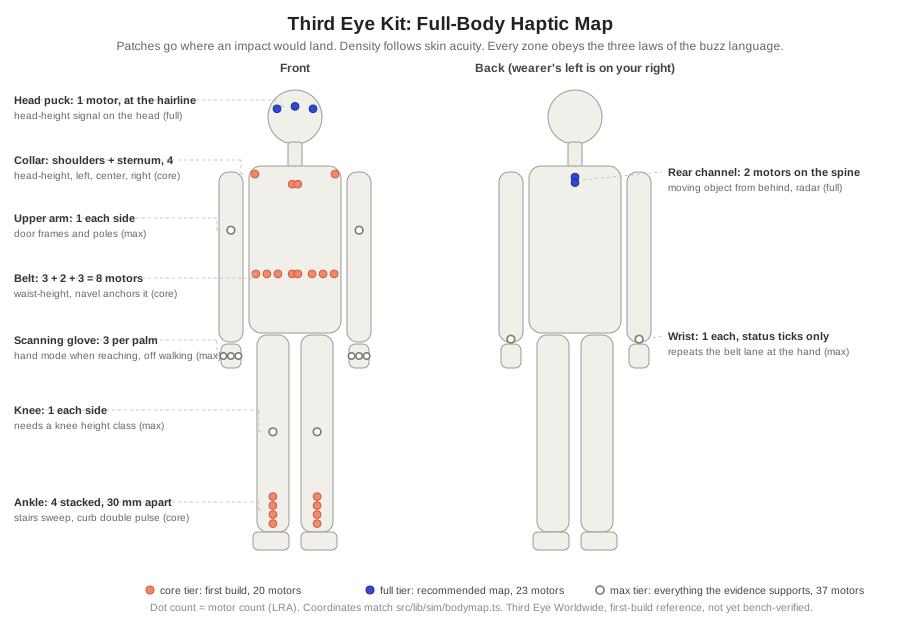
A study of where vibration patches should sit on the body, how many, how dense, and why. Written for the founder. Every number links to its source. Companion files: src/lib/sim/bodymap.ts (the machine-readable zone catalog) and public/schematics/08_full_body_haptic_map.svg (the picture).
House rules kept: short plain sentences, no long dashes, "blind and low-vision people" or "a blind or visually impaired person", never a machine word.
The answer in one paragraph
Put the vibration where the body would be hit, not where the skin is most sensitive. The evidence says the head is hit most often and worst: in a survey of 307 blind and legally blind people, 13 percent hit their head on something at least once a month and 23 percent of those strikes needed medical care, while 7 percent fell at least monthly and 36 percent of falls had medical consequences (Manduchi and Kurniawan 2011). So the map keeps the proven core (a collar on the shoulder tops and upper chest, an eight-motor belt, and a four-motor band above each ankle, 20 motors) and adds two things the evidence supports strongly: a single head puck at the hairline, because the head is where branches and signs land and one motor there is counted correctly 94 percent of the time where five are counted 5 percent, and a two-motor rear channel on the upper spine, because nothing in the current design covers the space behind the wearer and the spine is the single best place on the body to feel a buzz while walking (Karuei et al. 2011). That is the recommended "full" map: 10 zones, 23 motors. A "max" map adds wrists, knees, upper arms and a hand-scanning glove for 37 motors; section 12 explains what each adds and why nothing else makes the cut. Thighs, feet and palms are left out on purpose: thighs and feet are the worst sites for feeling vibration while walking, and the palm must stay free for the mobility aid. Spacing follows skin acuity: 30 to 50 mm on the trunk, one motor on the head, one motor per limb site. Only the ankles carry a sweep, and they get four motors because three cannot show direction (wrist apparent-motion study, IEEE Transactions on Haptics 2018). Form factor: elastic bands and garment pockets, not skin adhesives. Adhesive haptic patches exist only as research prototypes, and a blind wearer needs something that self-locates on body landmarks every morning without sight. The phone camera is worth having as the "what is it" layer on a fixed wide lens at the chest; a rotating camera is not worth its weight, power or latency, and the safety loop stays on the distance sensors no matter what the camera does.
1. How well each body site reads vibration
Two terms, once. The two-point threshold is the smallest gap at which two touches feel like two touches instead of one. It is measured with pressure, not vibration, and it is the classic map of skin acuity (Weinstein 1968, as summarized here). Vibration behaves differently: it spreads through the skin as a surface wave, and people can tell two vibration points apart at distances well under the pressure threshold on the trunk, yet need larger gaps on the forearm. Where a vibration study exists we use it. Where none exists we fall back on the pressure numbers.
| Body site | Pressure two-point threshold | What vibration studies add | Reads vibration while walking? | Sources |
|---|---|---|---|---|
| Fingertips | 2 to 2.5 mm; 2 to 8 mm in clinical tables | The most acute skin on the body. | Not tested; hands are busy with the mobility aid. | Weinstein via PMC, Purves, Neuroscience, Bates clinical values |
| Palm | 8 to 12 mm | Rank 12 of 20 sites in Weinstein's data (20 is best). | Untested. We keep the palm free. | Bates values, Weinstein 1968, The Skin Senses, pp. 195 to 218 (rank order of 20 sites) |
| Forehead and temples | About 15 mm | Forehead has the lowest vibration threshold on the head. With seven motors 25 mm apart, people point to the buzzing motor within 5 to 8 mm, biased toward the midline. Two motors 25 mm apart fuse into one felt point about 90 percent of the time (the funneling illusion); at 50 mm and beyond that rarely happens. Hair slightly weakens vibration on hairy parts of the scalp; the forehead has none. | Head displays reacted to fastest in obstacle tests; walking data not published. | Gemperle values quoted in a US Army review, Myles, head tactile guidelines, Kerdegari et al. 2014, hair density study |
| Around the head (band) | Not measured | With 12 motors around the head, people count one active motor correctly 94 percent of the time, two motors only 40 percent, five motors 5 percent. Precision is worst at the very front and very back. Lesson: one motor at a time, few motors. | Not tested walking. | Dobrzynski et al. 2012 |
| Neck and collarbone area | Rank 14 of 20 for the cheek; neck not in the classic table | Directional patterns on a neck collar or necklace are recognized better than single points. Walking and a mental task do not lower accuracy but raise effort. The front of the throat is less sensitive; keep motors off it. | Yes, accuracy holds while mobile. | HaptiCollar 2023, HaptiNecklace 2023, Haptic Collar 2019 |
| Shoulders and upper chest | Shoulder ranks 5 of 20 (coarse); chest 7 of 20 | Trunk skin tells vibration points apart at 30 mm with 91 percent accuracy, 20 mm at 82 percent, 13 mm at 64 percent. A 40 mm grid is the standard vest spacing. | Chest is among the sites least affected by walking. | Weinstein 1968, The Skin Senses (rank order), Johannesson et al. 2017, Karuei et al. 2011 |
| Upper arm | Rank 3 of 20 (coarse) | No spacing study found. | Arms lose less detection while walking than most sites, and people rank them second favorite. | Weinstein 1968, The Skin Senses (rank order), Karuei et al. 2011 |
| Forearm | 35 to 40 mm | Two simultaneous vibrations are best told apart at 90 mm, and their orientation cannot be judged reliably. Vibration is still above threshold 24 mm from the motor and measurable at 40 mm; 80 mm spacing avoids interference. Localization is best next to the wrist and elbow (landmarks) and worst mid-forearm. | See wrist. | Gemperle values, Purves, forearm vibrotactile two-point study 2025, Sofia and Jones 2013, arm propagation study 2019, Cholewiak and Collins 2003 |
| Wrist (back of) | As forearm | Best detection site on the body together with the spine; most preferred; least affected by walking along with chest and arms. | Yes, the best. | Karuei et al. 2011 |
| Abdomen and waist | About 40 mm on the trunk | Around the waist, 8 motors 107 mm apart are localized 98 percent; 12 motors 72 mm apart drop to 74 percent. Motors at the navel and the spine are localized almost perfectly because they sit on landmarks; the flanks fall to about 65 to 70 percent. | Stomach detection was not lowered by walking. | Weinstein via PMC, Cholewiak 2004 numbers, quoted in a 2021 torso study, Cholewiak 2004 abstract, Karuei et al. 2011 |
| Back and lower back | 39 mm; 30 to 40 mm in clinical tables | Side-to-side acuity is about 31 mm, up-and-down about 66 mm, so a vertical pair must be spaced twice as far as a horizontal pair to feel like two. Acuity is the same over the whole back. Spine 4 cm below the neck bone was the best detection site tested, and walking did not lower it. | Yes, the best with the wrist. | Gemperle values, Bates values, back acuity study 2024, Karuei et al. 2011 |
| Hips | As waist | Covered by the belt's outer motors on the flank (65 to 70 percent localization, fine for a three-motor group that fires together). | As waist. | Cholewiak 2004 |
| Thigh | Rank 2 of 20 (second coarsest) | As bad as the feet for detection, the most affected by walking, and the second least liked site. | No. Reject. | Weinstein 1968, The Skin Senses (rank order), Karuei et al. 2011 |
| Knee and upper shin | Calf 45 mm; shins 30 to 40 mm | No vibration study found. Bony sites carry surface waves further. | Not tested. | Gemperle values, Bates values |
| Calf and lower shin | 45 mm; rank 1 of 20 (coarsest) | No spacing study found. A four-motor stack here only needs to show direction of a stroke, not four separate points, so coarse skin is acceptable. | Lower legs move most while walking, so drive stronger. | Gemperle values, Weinstein 1968, The Skin Senses (rank order) |
| Top of the foot | Not in the classic table | Worst detection of 13 sites, most affected by walking, least liked by far. | No. Reject for signals. | Karuei et al. 2011 |
| Sole and big toe | Sole rank 9, big toe rank 11 of 20 | A 16-motor insole works for left, right, forward, back directions but not for shapes. Blind participants did better than sighted ones on some tasks. Footfall masks the sole at every step. | Poor while walking. | Weinstein 1968, The Skin Senses (rank order), Velazquez 2012 |
Two cross-cutting facts. First, walking lowers the odds of feeling any buzz and slows the reaction, so a safety signal must be driven harder than a comfortable notification (Karuei et al. 2011). Second, all of that study's motors sat on bare skin under sports tape, except the feet under socks. Nobody has published detection rates through a shirt and a jacket while walking. That is the first bench question.
2. Where blind pedestrians collide and get hurt
| Body part | What hits it | Numbers | Sources |
|---|---|---|---|
| Head and face | Outdoors: tree branches (the majority), poles and signs, construction equipment, trucks. Indoors: doors and cabinets left ajar, shelves and tables, the underside of staircases, walls. | 307 respondents. Only 2 percent of blind respondents had never hit their head (12 percent of legally blind respondents). 13 percent hit their head at least monthly. 86 percent of strikes were outdoors. 23 percent had medical consequences; of those, 60 percent needed a professional (stitches, staples, dental work). 43 percent changed how they walk, mostly slower and with an arm raised. 26 percent lost confidence. Mobility aid users and dog guide users had the same rate. | Manduchi and Kurniawan 2011 |
| Whole body, falls | Trips on curbs, steps, unexpected objects; misjudged distances. | Only 8 percent of blind respondents had never fallen. 7 percent fell at least monthly. 36 percent of falls had medical consequences, 63 percent of those needing a professional, up to orthopedic surgery. 51 percent changed their walking habits. People who bump their head more also fall more. Across 31 studies, reduced vision means 1.7 times the risk of a fall, 1.9 times the risk of repeated falls, and 1.3 to 1.9 times the odds of a hip fracture. | Manduchi and Kurniawan 2011, Legood et al. 2002 |
| Shins, knees, feet | Low street furniture: posts, poles, bollards, bins, low signs. Curbs and steps. | The mobility aid is swung about an inch wider than the body and covers about 85 percent of the path on average. With a standard-length mobility aid, trained users detected drop-offs 79.5 percent of the time; a longer mobility aid fell to 67.6 percent. No study counts shin or knee injuries separately. | RNIB on street furniture, mobility aid technique and tip study, mobility aid biomechanics, 10,069 trials, mobility aid length and drop-off detection |
| Shoulders and upper arms | Door frames, pole edges, sign edges at shoulder height. | Not counted separately. The habit of walking with an arm raised to shield the head (reported by most of the 43 percent who changed habits) puts the arm in the strike path. | Manduchi and Kurniawan 2011 |
| Hands | Reaching into an obstacle. | No injury data found. | Gap. |
| Behind the wearer | Cyclists, cars, carts. | Outside the survey above, which covered only static obstacles. Radar in the kit tracks moving targets to 8 m (see the v2 spec, section 4). | docs/simulator-v2-spec.md |
The picture is clear. The head is the most frequent and most injurious single target, the ground is the second, and the mobility aid already does a fair job on the ground. The whole-body map therefore spends its first extra motors on the head, then on what a mobility aid never touches: things at shoulder and knee height, and things behind.
3. The placement principle
- Where it buzzes is where it would hit you. Each zone sits on the skin that the obstacle would strike: forehead for branches, shoulder tops for poles, waist for tables and people, shins for curbs and steps, spine for something coming from behind. A zone never stands in for a different body part.
- Density follows skin acuity. Two motors that must be told apart are spaced at or above the vibration discrimination distance for that site: 30 to 50 mm on the trunk (Johannesson et al. 2017), 50 mm on the forehead (Kerdegari et al. 2014), one motor per site on the limbs where 80 to 90 mm would be needed (arm propagation study, forearm two-point study). Motors that fire as one group (the three on each side of the belt) are spaced for felt area, not for separation.
- Landmarks anchor the map. Motors go next to the navel, the spine, the collarbone notch, the shoulder tops, the kneecap and the ankle bone, because people localize best next to a body landmark (Cholewiak 2004, Cholewiak and Collins 2003) and because a blind wearer can find a landmark by touch every morning.
- Prefer sites that keep working while walking: spine, wrists, chest, arms, stomach. Avoid thighs and feet (Karuei et al. 2011).
- Keep the hands free. The palm and fingers read the mobility aid and the world.
- Every zone obeys the three laws in section 5 of the v2 spec: place equals impact site, strength equals closeness, and motion only where motion is the message (stairs).
4. The zone catalog
Coordinates are 0 to 1 over a standing figure: x from the wearer's own left to right, y from the top of the head to the sole. "Region" is the signal the zone renders; the eight core region keys are unchanged from types.ts, and backC has since been adopted there for the full tier. Four further keys are proposed and marked: kneeL, kneeR, palmL, palmR.
| Zone | View | Motors | Spacing | Site acuity | Impact | Region | Tier | Why here |
|---|---|---|---|---|---|---|---|---|
| Left shoulder top | front | 1 | single | 40 mm | high | collarL | core | A branch or pole on the left lands on the left side of the head and shoulder. Firm, hairless landmark. |
| Upper chest below the notch | front | 2 | 40 mm | 30 mm | high | collarC | core | Head-height hazard straight ahead. Two motors read as one clear center point. |
| Right shoulder top | front | 1 | single | 40 mm | high | collarR | core | Mirror. |
| Left waist and flank | front | 3 | 50 mm | 30 mm | high | beltL | core | The proven eight-motor belt. The three fire as a group. |
| Navel | front | 2 | 40 mm | 30 mm | high | beltC | core | Navel localization is close to perfect. |
| Right waist and flank | front | 3 | 50 mm | 30 mm | high | beltR | core | Mirror. |
| Left lower shin above the ankle | front | 4 stacked | 30 mm | 45 mm | high | ankleL | core | Curbs, steps and low objects. Four motors are the minimum for a readable sweep. |
| Right lower shin above the ankle | front | 4 stacked | 30 mm | 45 mm | high | ankleR | core | Mirror. Both fire together for ground hazards. |
| Head puck at the hairline | front | 1 | single | 15 mm | high | collarC | full | The head is the impact site. One motor: a single active head motor is counted correctly 94 percent of the time, two 40 percent, five 5 percent. Sits off the bone and comes off in one motion. |
| Left forehead toward the temple | front | 1 | 50 mm to center | 15 mm | high | collarL | max | Shelved in design review: a second and third head motor lower counting accuracy. Kept in the catalog for a future test. |
| Right forehead toward the temple | front | 1 | 50 mm to center | 15 mm | high | collarR | max | Mirror. |
| Upper spine between the shoulder blades | back | 2 stacked | 40 mm | 66 mm vertical | medium | backC (new) | full | Nothing covers "behind". The spine is the best detection site while walking. The pair acts as one channel. |
| Back of left wrist | back | 1 | single | 40 mm | low | beltL | max | Best detected and best liked site; repeats the waist lane at the hand that reaches. No injury data, so optional. |
| Back of right wrist | back | 1 | single | 40 mm | low | beltR | max | Mirror. |
| Left upper shin below the kneecap | front | 1 | single | 45 mm | medium | kneeL (new) | max | Bollards, planters, chairs. Needs a knee height class in the sensor model. |
| Right upper shin below the kneecap | front | 1 | single | 45 mm | medium | kneeR (new) | max | Mirror. |
| Outer left upper arm | front | 1 | single | 40 mm | medium | collarL | max | Doorways and poles clip the arm when the body clears. |
| Outer right upper arm | front | 1 | single | 40 mm | medium | collarR | max | Mirror. |
| Left palm, three across (scanning glove) | front | 3 | 25 mm | 12 mm | low | palmL (new) | max | A hand-scanning mode, not a walking signal. Used when the hand reaches for a doorway, a table edge, a handrail or a seat. See section 12. |
| Right palm, three across (scanning glove) | front | 3 | 25 mm | 12 mm | low | palmR (new) | max | Mirror. On the mobility aid hand the three motors move to the finger backs. |
Counts: core 8 zones and 20 motors (the current contract, unchanged). Full 10 zones and 23 motors (recommended). Max 20 zones and 37 motors, of which 6 belong to the scanning glove and are off while walking, and 2 are the shelved forehead side motors.
Sites rejected on evidence: thighs and top of foot (worst detection while walking, least liked), sole (masked by every footfall; direction only), palm and fingers as walking signals (they must stay free for the mobility aid and for touch; the scanning glove in section 12 is a separate hand mode), calves (coarsest skin and not a strike surface), front of the throat (less sensitive, uncomfortable).
Why the head puck is "full" and not "core": it is the strongest single upgrade in the map because it moves the most dangerous signal onto the body part that takes the hit. One motor, not three: one active head motor is counted correctly 94 percent of the time, two 40 percent, five 5 percent (Dobrzynski et al. 2012), so the puck carries the collar's center signal and the collar's shoulder motors keep left and right. It is not core because a head-worn piece is a visible, daily commitment that some wearers will decline. The software must treat the puck as an optional renderer of the collar's center region: when it is absent, the collar carries the signal alone; when present, both carry it.
Why the rear channel is "full": radar already exists in the kit and reports moving targets to 8 m, but the current eight regions have no way to say "behind you". The upper spine is the best place on the body to feel a buzz while walking (Karuei et al. 2011) and it is empty. This needs a rear-facing radar on the belt, which is a hub decision.
5. Patch form factor: adhesive patches, bands, or a hybrid
What exists in skin-adhesive haptics, honestly:
- 2019, Nature: a wireless, battery-free patch with 32 vibration actuators in soft silicone, under 3 mm thick, more than 700 components, powered by radio from an antenna that must be within 30 to 50 cm, using under 2 mW per signal where a conventional motor needs about 100 mW. It attaches with a "reversible, soft adhesive" elastomer layer. It was built for virtual reality and prosthetics demos (Yu et al. 2019, specs in trade coverage, antenna range).
- 2022, Nature Electronics: a battery-powered, phone-controlled version with 0.73 actuators per square centimeter that works on every body region except the hands and face (Jung et al. 2022, summary).
- 2024, Nature: a patch of 19 bistable actuators that hold a pressed state without power, driven over Bluetooth, and demonstrated as a navigation aid fed by a phone's LiDAR scanner, with blindfolded users steering around obstacles (Flavin et al. 2024, Northwestern release). This is the closest thing in the literature to what the founder wants.
- 2025, Science: actuators that push, shear, twist and vibrate in any direction on the skin (Ha et al. 2025).
None of these is a product you can buy, and none reports multi-day wear on a person who sweats, walks, and showers. What the adhesive industry does report: skin-contact adhesives are rated for up to 7 days (short wear), 14 days (medium) or 21 days (long), and they fail from sweat, skin oil, hair, movement, and the skin's own shedding cycle of 7 to 14 days (Avery Dennison, choosing an adhesive, Avery Dennison on skin adhesion). Hairy sites (shins, forearms, upper arms) are the worst case, and those are exactly the limb sites in this map.
The three options:
| Option | For | Against |
|---|---|---|
| Adhesive epidermal patches | Thinnest, lightest, no straps, dense arrays possible, the research demos are stunning. | Research-grade only. Wireless power needs a nearby antenna or a battery per patch. Adhesive fails with sweat, oil, hair and movement, and a blind wearer cannot see when a corner has lifted. Placing a patch accurately without sight, daily, has no published method. Skin must rest between wears. |
| Elastic bands and garment pockets | Every study in section 1 used them or tape. Bands self-locate on landmarks (ankle bone, kneecap, navel, collarbone, brow). Washable, replaceable, no skin load. Motors are held under known pressure, which matters because a lifted motor feels like nothing. | Bulkier. Can slip on smooth fabric. Comfort at the waist and head depends on tension. |
| Hybrid: bands for trunk and limbs, one adhesive patch for the forehead | Forehead is hairless, flat and stays dry-ish; a small patch there could beat a head puck socially. | Same reapplication problem in miniature. A head puck already sits inside a cap or hat and needs no skin bond. |
Decision: bands and garment-integrated pockets for the whole map, no skin adhesives in the first two builds. The collar becomes a yoke that rests on the shoulders with the center pad at the notch of the collarbones. The belt keeps its buckle centered on the navel. The ankle band's seam sits on the ankle bone with the motor stack on the shin side. The head puck sits at the hairline on a soft band or inside a cap, with a raised center mark. The rear channel lives in the collar yoke's back strap. This is the choice that a blind wearer can put on correctly every day without sight, and that the evidence base actually tested. Revisit adhesive patches when a product exists with replaceable adhesive rated for at least one full day of sweat and walking.
6. The sweep zones and why they get four motors
Apparent tactile motion is the illusion that a row of motors fired one after another feels like a single stroke moving along the skin. The stroke needs two timings: how long each motor buzzes (the burst) and the gap between one motor starting and the next starting (the onset gap). The Tactile Brush study measured the best onset gap as 0.32 times the burst plus 47.3 ms (Israr and Poupyrev 2011). For the kit's 120 ms burst that gives 85.7 ms, which matches the 80 ms onset gap already in types.ts.
How many motors: a forced-choice test around the wrist found that three motors do not produce a circular motion illusion at all, while four and six motors gave the same rate of correct direction; six felt continuous where four did not. An earlier upper-arm study likewise found no gain beyond four (IEEE Transactions on Haptics 2018, open copy, publisher page). Four is therefore the minimum, six is a comfort upgrade if the band has room.
Which zones sweep: only the two ankle zones, stacked vertically, 30 mm apart, bottom to top for stairs up and top to bottom for stairs down, repeating every 800 ms. Every other zone is a steady buzz, because steady signals are read faster and more reliably than moving ones (v2 spec, section 1), because fusing several head motors at once confuses people (Dobrzynski et al. 2012), and because the belt's job is direction, which its layout already encodes. The 30 mm ankle spacing is below the 45 mm pressure threshold of that skin on purpose: for a sweep, some blurring between neighbors helps the stroke feel continuous.
7. Power, weight and cost per tier
Parts and their sourced numbers:
- Motor: a 10 mm coin linear resonant actuator (LRA, a small motor that hums at one fixed frequency). Reference part C10-100: 1.37 g, 2 V rms rated, 69 mA typical and 90 mA maximum, 175 Hz, 1.5 G (datasheet, store page). At rated drive that is about 0.14 W while buzzing.
- Driver: one DRV2605L per motor. Its I2C address is fixed at 0x5A, so several drivers cannot share a plain bus (datasheet, Adafruit note). It draws 2.4 to 3.5 mA average while running in LRA mode and starts in 0.7 ms (datasheet).
- Bus fan-out: a TCA9548A multiplexer (a switch that gives one I2C bus eight separate lanes) has eight selectable addresses, so up to 64 drivers can hang off one bus (TI application note, Adafruit 2717).
- Battery: a 3.7 V, 2000 mAh pouch cell stores 7.4 Wh (3.7 V times 2 Ah) and weighs about 34 to 45 g depending on the model (Adafruit 2011, Mikroe).
Budget per tier (motors, drivers and multiplexers only; the hub, sensors and radio belong to the hub spec):
| Per tier | Core (20) | Full (23) | Max (37) |
|---|---|---|---|
| Motor mass (1.37 g each) | 27 g | 32 g | 51 g |
| Multiplexers needed (8 drivers each) | 3 | 3 | 5 |
| Peak motor power if every motor buzzes at rated level (0.14 W each) | 2.8 W | 3.2 W | 5.2 W |
| Driver idle draw if all drivers are awake (3 mA at 3.7 V each) | 0.22 W | 0.26 W | 0.41 W |
| Parts cost at 1,000 pieces (LRA 4.52 + driver 1.12 per motor, plus muxes) | not published | not published | not published |
| Prototype parts cost (LRA 6.50 + breakout 7.95 per motor) | not published | not published | not published |
The max column counts the scanning glove's six motors (section 12), which are off while walking, so its two power rows are a ceiling rather than a walking load.
A worked battery example, with the assumptions stated: on a busy street the buzz language rarely lights more than three motors at once, and the rhythm keeps each at roughly half duty, so motors average about 3 times 0.14 W times 0.5, which is 0.21 W. If the drivers are put to sleep between bursts their idle draw is negligible; if left awake the core tier adds 0.22 W. The 7.4 Wh pack then runs the haptic layer for about 17 hours with drivers awake and about 35 hours with drivers asleep. These are estimates from the sourced part numbers, not measurements. The bench must log real duty cycles on a real walk.
Weight of straps, cables and the hub is not in the table because there is no source for it yet; it must be weighed at the bench. The sourced parts alone put the full tier at about 32 g of motors plus a 34 to 45 g battery.
8. Wearability rules
Joints. No motor sits on a joint line. The ankle stack sits above the ankle bone on the shin side; the knee motor sits below the kneecap on the flat of the upper shin; the wrist motor sits on the flat back of the wrist, not the crease; the arm motor sits on the outer upper arm away from the elbow. Bands over joints are elastic, so they flex instead of lifting a motor off the skin.
Clothing. The belt and collar will be worn over a shirt in real life. No published study measured detection through clothing while walking; the closest data had motors on bare skin (Karuei et al. 2011). Plan for it: motors face inward under a firm band so fabric is pressed, not draped, and the intensity floor is set per zone at the bench with a T-shirt and a jacket on. Ankle bands go over the sock or over the trouser hem, and the sweep must be checked in both.
Sweat and hair. Bands with a wicking inner face. Adhesives are ruled out (section 5) partly because sweat and hair defeat them. The forehead has no hair; the shins, forearms and upper arms do, and hair slightly weakens the coupling (hair density study), so drive limb zones a step harder.
Placing patches without sight. Every band self-indexes on a landmark that the wearer can find by touch:
- Belt: buckle centered on the navel; the two center motors straddle it. Left and right groups then fall on the flanks by construction.
- Collar yoke: rests on the shoulders; the center pad has a raised bar that sits in the notch between the collarbones; the two shoulder motors sit where a backpack strap would.
- Ankle bands: a raised seam sits on the outer ankle bone; the motor stack then faces the shin. Left and right bands differ by touch: one bump on the left band, two bumps on the right.
- Head puck: a raised center mark goes above the nose at the hairline; the single motor sits on the midline.
- Wrist bands: worn like a watch, face on the back of the wrist.
- Knee bands: lower edge on the top of the shin bone bump below the kneecap.
Tactile templates: each band carries raised dots at every motor position, so the wearer can check a motor by feel, and each cable connector is keyed so left and right cannot be swapped. A start-up self-test buzzes every zone in a fixed order (belt center, belt left, belt right, collar center, collar left, collar right, left ankle bottom to top, right ankle bottom to top, head puck, spine) so the wearer confirms placement in ten seconds. Same order every day: belt, collar, ankles, then the head puck.
Comfort. Too tight numbs the skin; too loose lifts the motor. Bands should hold a motor with firm contact but leave no mark after an hour. The front of the throat is off limits. A backpack strap over the spine pair must not press on the motors.
9. The camera question
The founder wants the option of using the wearer's own phone as the AI and vision layer, mounted at the chest or belt, and asked whether a camera that rotates or scans is worth it.
Field of view (how wide the camera sees). A phone's main camera is a 26 mm equivalent lens, about 80 degrees across the diagonal; the ultra-wide is a 13 mm equivalent with a 120 degree field (dpreview). A chest-worn system with a 30 degree camera made it "extremely challenging" for blind users to keep a crosswalk signal in view (Frontiers in Electronics 2021), so width matters more than movement. The purpose-built biped harness uses 170 degree cameras, weighs 950 g and runs 6 hours (New Atlas). A phone's ultra-wide at 120 degrees, fixed to the chest, covers the whole walking lane and both shoulders without moving.
Does a chest-mounted phone camera help? Yes, measurably. Mobilio, a phone app that reads the live camera, GPS, motion sensors and LiDAR, let 14 blind and low-vision volunteers walk an outdoor route 13 percent faster than with a maps app and a mobility aid, and cut obstacle contacts on an indoor course by 41 percent (TechXplore, August 2026).
A rotating or scanning camera. A phone gimbal weighs 305 g plus a 25 g clamp and needs its own battery, good for 6 hours 24 minutes (DJI Osmo Mobile 6 specs). It adds moving parts, motor noise, and a moving frame of reference that the software must undo before it can say where anything is. A scanning camera also trades time for width: while it looks left it is blind to the right. Verdict: not worth it. A fixed 120 degree lens plus the wearer's own head and body turns gives the same coverage with no mechanics. If more width is ever needed, a second fixed camera beats one that moves.
Latency and power. Camera light-in to picture-out on a current Android phone is 80 ms plus or minus 25 ms (inovex 2023). A small detector such as YOLOv8n runs in about 10 to 11 ms on an iPhone's Neural Engine (Ultralytics CoreML docs). The phone-to-belt Bluetooth link cannot go below a 15 ms connection interval on iOS (Punch Through). Best case, a camera warning reaches the skin in roughly 110 to 150 ms; the kit's distance-sensor path is about 70 ms for a hazard ahead and about 120 ms for the ground, modeled from the parts' datasheets until the bench measures it (the design review accounting). Continuous detection at 15 frames per second drew about 3.7 W on a test phone, with camera capture and preview alone taking 45 to 70 percent of each frame's energy (energy study, arXiv 2020), so expect a warm phone and roughly four hours from a typical phone battery. Cameras also fail in the dark, in glare, in rain, and on glass.
Why the safety loop stays on the distance sensors regardless. The laser grid, radar and sonar report distance at a fixed rate with no dependence on light, network or the phone's thermal state, and a belt of time-of-flight sensors with haptics produced zero collisions in blindfolded trials (ALVU, cited in the v2 spec). The camera is the "what is it" layer: labels, text, signs, faces, path planning, and the LiDAR in some phones as a third distance source with a 5 m reach (How-To Geek), which is exactly how the 2024 Nature patch demo used it (Northwestern release). The camera may add a buzz; it must never be the only thing that can cause one. If the phone dies, the kit still buzzes.
Recommendation: a fixed chest mount for the wearer's own phone, ultra-wide lens, landscape, no gimbal. The belt hub keeps the sensors and the motors. The phone talks to the hub over Bluetooth and is allowed to enrich, not to decide.
10. Open questions for the bench
- Detection through clothing while walking: the intensity floor per zone with a T-shirt and a jacket on. No published numbers exist.
- The ankle sweep on real stairs: four versus six motors, 120 and 80 ms versus 240 and 120 ms, and the up-versus-down confusion rate.
- Head puck uptake: will wearers put it on daily, and how much faster do they react to head-height hazards with it than with the collar alone?
- Rear channel: false alarm rate from radar in a crowd, and comfort of the spine pair under a backpack.
- Knee height class: can the down-tilted laser grid separate knee-height objects from ground and waist reliably enough to earn the two knee motors?
- Placement repeatability without sight: day-to-day motor position error with the tactile templates, target under 20 mm on the trunk and under 10 mm on the forehead.
- Skin adhesives: re-test when a product exists; measure wear time with sweat and on hairy sites.
- Motor rise and stop times with the driver's overdrive and braking, and whether both survive the 800 ms sweep repeat.
- Fast walking: the walking data came from a 2.4 km/h treadmill; the kit's default pace is 1.4 m/s, about 5 km/h.
- Per-wearer calibration: men and women differed a little by site in the detection study; make the intensity floor a per-zone setting.
11. Correction note
The first ankle-band schematic, public/schematics/07_ankle_band.svg, showed three stacked motors and said "the three motors fire in sequence". The evidence says three motors cannot produce a readable direction; four can, and six add continuity but no accuracy (wrist apparent-motion study). types.ts carries four per ankle, and the schematic has since been redrawn with four motors. The head puck and the 23-motor full tier in this document follow later design review decisions; the design review record lists every change.
12. More places: what the evidence allows
The founder asked whether vibration should go in more places than the full tier. The short answer: yes, in three more places and one hand mode, and then no further. Every other site fails one of two tests, and the literature also puts a price on "more" itself. In the body-site detection study, people reacted more slowly when a buzz could come from any of several sites than when they knew where to attend, and the authors advise caution about spreading a display across the body when reaction time matters (Karuei et al. 2011). On the head, people count one active motor correctly 94 percent of the time, two motors 40 percent, five motors 5 percent (Dobrzynski et al. 2012). Around the waist, going from 8 motors to 12 dropped localization from 98 percent to 74 percent (Cholewiak 2004, quoted here). More motors can mean less information.
The max tier is the answer to "more"
| Zone | What it adds | The evidence |
|---|---|---|
| Wrists, one motor on the back of each | Repeats the waist lane at the hand that reaches, on the site that reads vibration best while walking. | Wrists and spine were the best-detected and best-liked sites of 13 tested, and walking degraded them least (Karuei et al. 2011). A wrist bracelet guiding the hand to an object gave 90.6 percent localization in 41 blind and partially sighted people; 15 of them grasped better with vibration than with sound (Scientific Reports 2025). No injury data for hands exist, so the wrist stays optional. |
| Upper arms, one motor on the outer side of each | Door frames and pole edges that clear the body but clip the arm. | Arms lost less detection while walking than most sites and ranked second favorite (Karuei et al. 2011). Indoor head-level accidents come mostly from doors and cabinets left ajar and from shelves, and 43 percent of people who changed their habits after a strike now walk with an arm raised, which puts the arm in the strike path (Manduchi and Kurniawan 2011). |
| Knees, one motor below each kneecap | Knee-height street furniture the mobility aid arc can miss. | Posts, bollards, bins and low signs are named hazards (RNIB); mobility aid coverage averages about 85 percent of the path (mobility aid biomechanics, 10,069 trials). Needs a knee height class in the sensor model first. |
Those six motors, with the two shelved forehead side motors, take the map from 23 to 31. The scanning glove below adds six more, for 37, but they are a different kind of thing.
The scanning glove: a hand mode, not a walking signal
The v2 body map drew scanning gloves with a palm buzz in the same buzz language. The addendum keeps that idea and narrows it. The glove is for the moment a hand reaches out: to find a doorway, a table edge, a handrail, an empty seat. That is already how orientation and mobility teaches a blind or visually impaired person to move through unknown rooms. In the upper hand and forearm technique the arm is raised to shoulder height, the forearm crosses in front of the body, the fingers curl and the palm turns outward; in trailing, the hand rides along a wall with the fingers angled away from it so they do not jam on door frames (APH orientation and mobility text). The glove gives that reaching hand a reach beyond its fingertips.
How it works: a small distance sensor on the back of the hand looks where the hand points. Three motors across the palm, at the thumb side, the center and the little-finger side, say where the nearest surface is across the hand's width. Strength says how close, as everywhere else in the kit. That is the belt's left, center, right logic shrunk to the hand, so the wearer learns nothing new. It maps to two new region keys, palmL and palmR, fed by the hand sensor, and it is off unless the wearer switches it on. It never milestones the belt, collar or ankle loop.
Why the hand can carry it, and why three motors and not more:
- Palm skin tells two touches apart at 8 to 12 mm and fingertips at 2 to 2.5 mm, the finest on the body (Bates clinical values, Weinstein via PMC). The palms carry about 15 percent of all the body's touch nerve fibers (Corniani and Saal 2020).
- A 3 by 3 grid of motors on the palm is localized at 91 percent (palm vibration study 2023). With motors on the fingertips and the palm heel, three locations across the hand are told apart 97 percent of the time, four at 82 percent, five at 71 percent (IEEE Transactions on Haptics 2023). Three across is the sweet spot; more costs accuracy.
- Dense finger arrays are not read well: a 24-motor glove was localized correctly on only 70 percent of trials at the fingertip segments and 50 percent at the finger bases (ReHaptic glove study, 2015).
- Moving the hand lowers detection of faint vibration on the arm and hand while leaving clearly felt vibration intact (Post et al. 1994). The glove must be driven well above threshold, like every zone in this map.
What glove navigation studies actually found:
- The first haptic glove for wayfinding, with a camera and wearable computer, was tested by nine blind and low-vision adults. Their paths through an obstacle course were no different from those with existing devices, and the hardware was judged cumbersome (Zelek et al. 2003).
- The Unfolding Space Glove puts a 3 by 3 grid of LRAs on the back of the hand and a time-of-flight camera with a 62 by 45 degree view, a 0.1 to 2 m range, 25 frames per second and about 50 ms latency. Eight blind and six blindfolded participants completed all 392 trials. Blindfolded participants were about 54 percent slower with the glove than with a mobility aid (47.9 versus 31.0 seconds); blind participants touched about as many obstacles with the glove as with the mobility aid (0.45 versus 0.40 per run) (Unfolding Space Glove, 2022). The authors chose the back of the hand because it keeps a discreet posture and preserves the hand's normal sensing and movement.
The lesson from both: a glove is learnable and works, but as a way of walking it is slower than a mobility aid. As a way of reaching it has no competitor. So the glove is a mode, switched on when the hand goes out, and the belt, collar and ankles keep the walking job.
Two placement rules follow. The fingertip pads stay bare, because a blind wearer reads the world with them; fingerpad-free finger devices already exist that put the actuator on the nail side or the finger sides and weigh about 5 g (Fingeret, 2022, nail-side device, 2025). And on the mobility aid hand the palm is full, so its three motors move to the backs of the index, middle and little fingers, which keeps the same thumb-side, center, little-finger-side meaning.
Sites rejected, with the reason
| Site | Reason | Evidence |
|---|---|---|
| Thighs | As bad as the feet for detection, the most degraded by walking, second least liked. | Karuei et al. 2011 |
| Calves | The coarsest skin of 20 sites, not a strike surface, and the ankle stack already carries the ground signal. | Weinstein 1968, The Skin Senses (rank order) |
| Soles and top of the foot | Feet were the worst site of 13 and the least liked by far; footfall masks the sole at every step; an insole conveys direction but not shape. | Karuei et al. 2011, Velazquez 2012 |
| Lower back | Not rejected for sensitivity: acuity is the same over the whole back. Rejected because the only signal that belongs behind the wearer already has a better home on the upper spine, the best-detected site while walking, and because the lower back sits under a backpack's lumbar pad and against every chair back. | back acuity study 2024, Karuei et al. 2011 |
| Belly, beyond the belt | The belt already sits there, and adding motors makes it worse: 8 motors around the waist are localized 98 percent, 12 motors 74 percent. | Cholewiak 2004, quoted here |
| More motors around the head | One active motor is counted correctly 94 percent of the time, two 40 percent, five 5 percent. One on the head is the choice; the two forehead side motors are shelved to the max tier. | Dobrzynski et al. 2012 |
| Front of the throat | Less sensitive than the rest of the neck and uncomfortable under pressure. | Haptic Collar 2019 |
| Fingertip pads | They read the world; a motor there blocks touch. The glove uses the palm or the finger backs. | Fingeret, 2022 |
The rule for any future zone request
A new zone must sit where the body would get hit or where a hand reaches, and the skin there must read vibration while the wearer is moving; if it fails either test, it is out.