I am blind or visually impaired: the story in one minute

The story

Feel the world before it touches you.

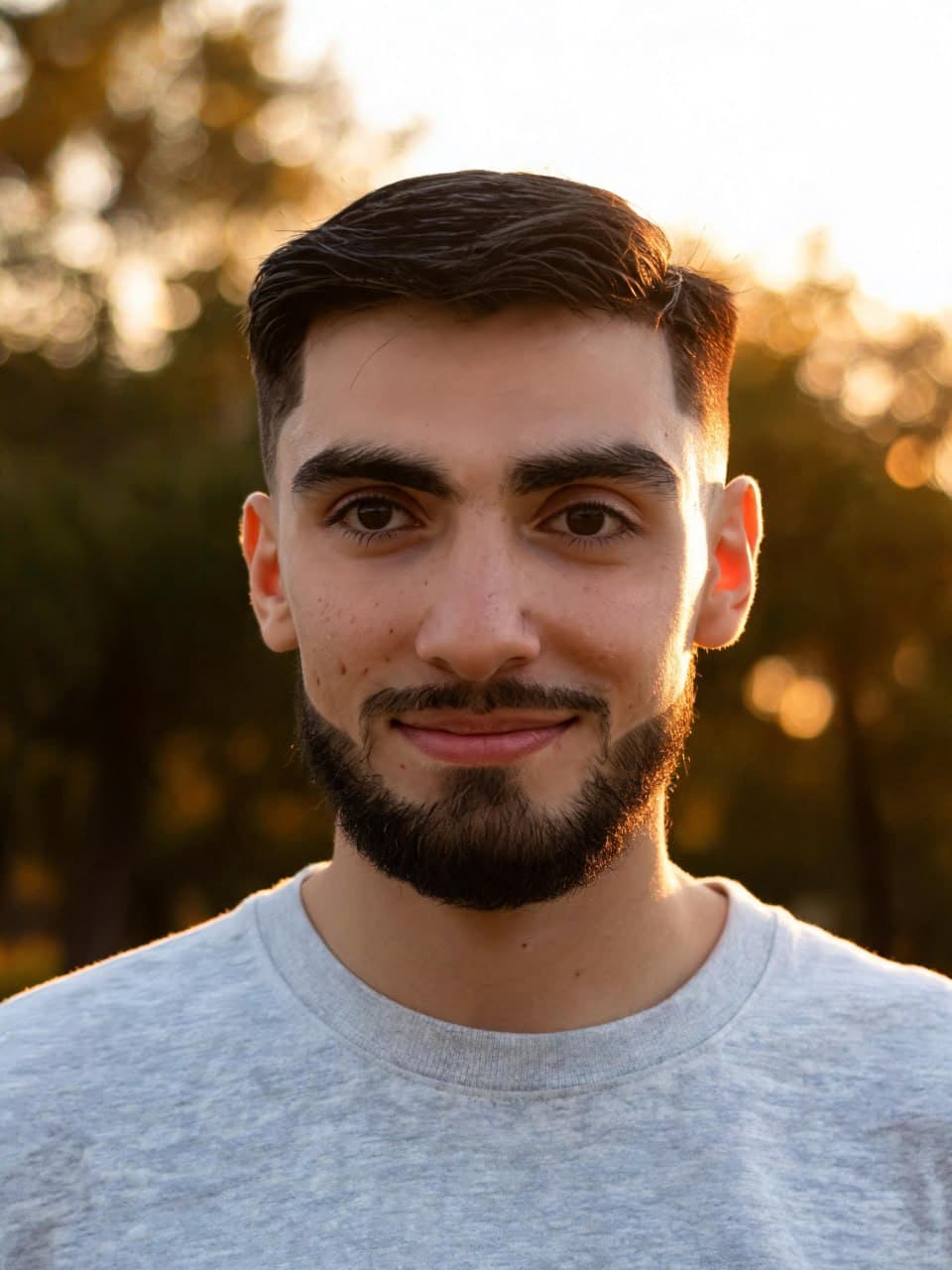
Said Mohaddes Sadeqi, portrait, outdoors at sunset

The story behind this, Said Mohaddes Sadeqi

I lost my sight. Then I built an eye for myself and others.

I lost my sight in the war and was blind in both eyes. I recovered sight in one eye. I am still blind in the other. I built the first Third Eye Kit at a blind support centre, where I was after losing my sight, before 2022, and brought it into use with blind and visually impaired people there. We built and gave out tens of first generation kits ourselves. Because the design was open, hundreds more were built by the people who needed them, with our help sourcing parts. It went to TEKNOFEST and came back a finalist, with Best Presentation. Now we are here, building the second generation.

The real problem is not the technology. It is whether a blind person anywhere in the world can get this, afford it, and rely on it. So we make it as cheap as it can be made. We build what works over what impresses. We publish everything, so that anyone can build it. And we build it so the people who wear it can turn it to anything else they want to understand: a room, a game, a place they have not been yet.

Mobility is not one need among many. It is what independence stands on. That is what this is for.

Said Mohaddes Sadeqi, founder, Third Eye Worldwide

THE FOUNDER'S POSITION

Why we are building it to replace the mobility aid

I use a mobility aid. I know what it gives a blind or visually impaired person, and I know where it stops: at the length of the mobility aid, at the ground, at the moment of contact. I did not build TEK to sit next to the mobility aid forever. I built it to do the mobility aid's job from the body, with both hands free. The first kit was already putting ground sensing on the body before 2022. The second generation is being built to finish that job. Believing it is not the same as proving it, so we have written down exactly what TEK has to pass before we tell anyone it can take the mobility aid's place. Until then, do not put your mobility aid down because of anything on this site.

The replacement test, in public, Using TEK today

The story, step by step

Nine steps, each one you can check.

  1. I lost my sight

    Blind in both eyes after the war in Afghanistan. Recovered sight in one. Still blind in the other.

    Said Mohaddes Sadeqi, portrait, outdoors at sunsetThe founder's portrait

  2. The first kit

    Built at a blind support centre, before 2022: glasses that spoke through an earphone, a vibrating band worn at the hand, and sensing shoes.

    Proof: The first generation record

  3. Into use

    Brought into use with blind and visually impaired people at the centre.

    Proof: The first generation record

  4. The lesson

    The wearers rejected voice guidance and asked to feel the world directly. Our own field experience, and the direction ever since.

    Proof: The lesson, in full

  5. Shown in many places

    Demonstrated at the centre, in Herat, and in Turkey.

    Proof: The timeline in Engineering

  6. TEKNOFEST 2022

    Finalist, and the Best Presentation award.

    Proof: The finalist listing (opens in a new tab)

  7. Open, so it spread

    We built and gave out tens of kits. Because the design was open, hundreds more were built by others, with our help sourcing parts.

    Proof: The open record

  8. The second generation

    20 motors in a belt, a collar strip, and two ankle bands. Two laser grids, radar, and sonar. Firmware specified and latency modeled; it is in testing now.

    Proof: The second generation build

  9. What comes next

    Tests, then the replacement test, then the glasses and TEK Reach, all on the roadmap.

    Proof: The test plan

Two generations

One in use. One in build.

VERSION 1, first generation

IN USE

Built before 2022. In use since 2022.

  • Born at a blind support centre, made by Said Mohaddes Sadeqi, tested at TEKNOFEST, and brought into use with blind and visually impaired people at that centre, in Herat, and in Turkey.
  • We built and gave out tens of first generation kits ourselves. Because the design was open, hundreds more were built by the people who needed them, with our help sourcing parts.
  • TEKNOFEST 2022 finalist and Best Presentation.
VERSION 2, second generation

IN BUILD

In build.

  • 20 motors in a belt, a collar strip, and two ankle bands.
  • Two laser grids, radar, and sonar. No camera in the warning path.
  • The wearer's own phone is the brain: camera, AI, and the text home on a chest mount. No extra computer.
  • About 70 ms from the world to the skin ahead, about 120 ms at the ground, modeled.

The assist frame, an exoskeleton for the legs and hips, is a later idea, planned only after all the tests pass. It is not part of the second generation build, it is not built, and it is not required.

Anyone, anywhere, can build this.

Our promise for the second generation: about three days of building, common parts, and a finished kit within about 10 days wherever you live. We are still testing it, and we will publish what a kit costs once the parts are final. The times are targets until builders outside our team time their own builds, and we will publish those times here.

Build time
about 3 days of buildingStatus: second generation target, being verified.
Finish anywhere
within about 10 days, including getting partsStatus: second generation target, being verified.
Parts cost
published once the parts are finalStatus: in testing.
First generation
built to be low cost from the startStatus: in use since 2022.
Steps
step count published with the second generation build guideStatus: pending.

The three-phase build path and the full parts list.

The lesson

They did not want to be told where to go.

The people who tested the first kit rejected voice guidance in the ear they already navigate by, and asked to feel the world directly. That is our own field experience, and it set the direction. The second generation became a language of vibration driven by direct measurement: distance sensors, a reflex controller, motors on the skin, and no interpreter in between.

How it feels

Three laws carry the whole language.

The first build speaks six signals: obstacle left, center, and right at the belt, head height at the collar, stairs up and stairs down at the ankles. How quickly they are learned is measured in the tests.

  1. LAW 01

    Where it buzzes is where it would hit you.

    Collar means duck. Belt means step aside. Ankles mean watch the ground.

  2. LAW 02

    How strong is how close.

    A faint buzz is a wall across the room. A strong buzz is a doorframe at your nose.

  3. LAW 03

    If it moves, follow the motion.

    Motors fire in sequence and the skin reads one stroke. A sweep rising at the ankle means stairs up. Falling means stairs down.

Where it goes

The head sees. The belt keeps you safe. The skin feels.

The second generation is nearing MVP. After it, the roadmap adds smart glasses, so the kit can describe the world on request while the belt keeps guarding it.

The head sees

A pair of smart glasses carries a small camera. When you ask, it describes the scene in words: the shop sign, the empty chair, the friend waving. Description is a helper, never a warning.

The belt keeps you safe

The belt goes on warning by itself, with its own sensors and its own small computer. Glasses on or off, phone charged or dead, the belt keeps warning on its own.

The skin feels

Distance stays a feeling on the body: where it buzzes is where it would hit you, the closer it is the more you feel it, and if it moves, the buzz follows the motion.

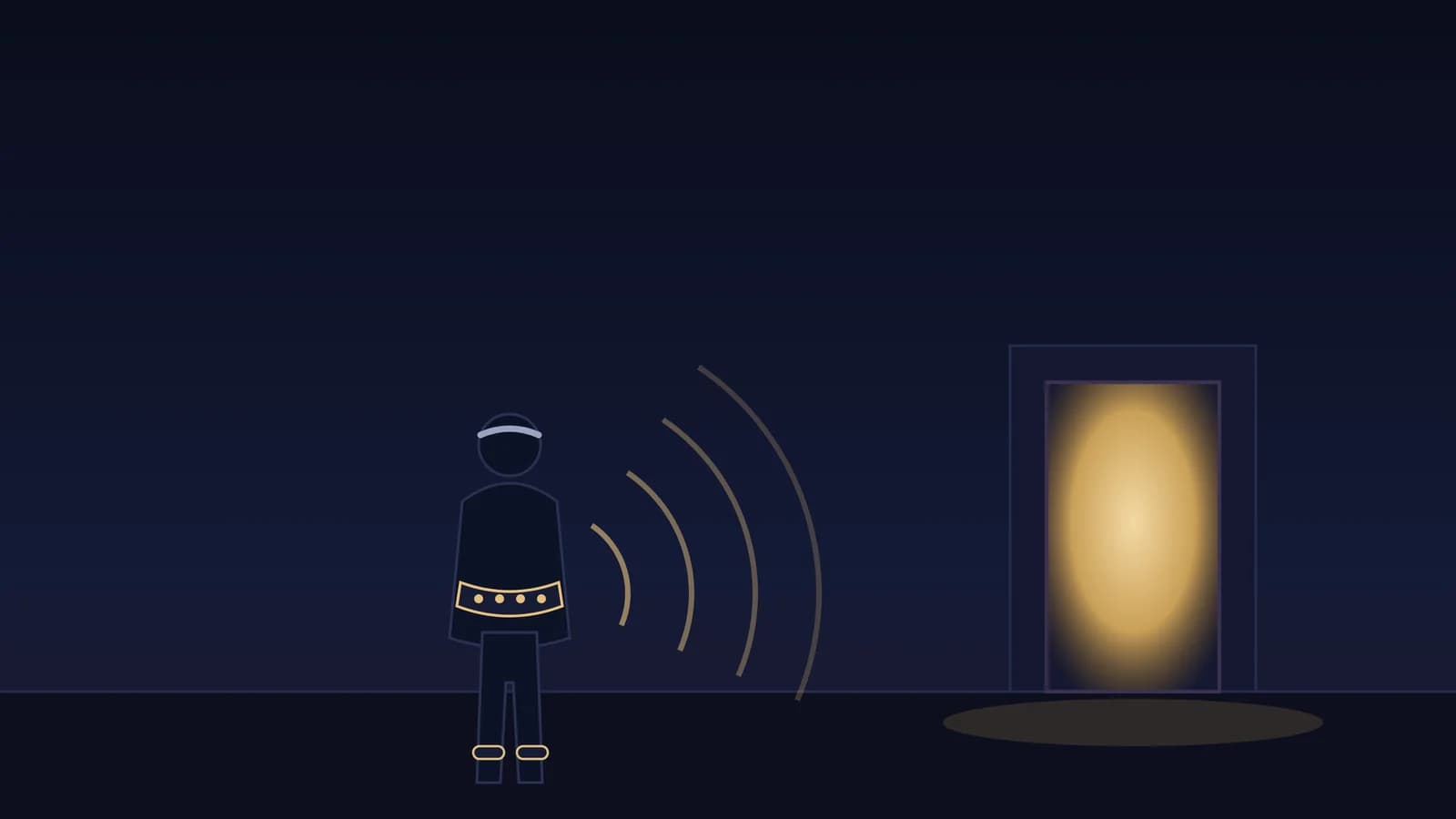
Illustration of a person from behind, wearing a slim glasses band, a belt with small pods, and ankle bands, facing a lit doorway. Soft amber arcs spread from the belt toward the doorway, showing the belt feeling the space ahead.
The direction, drawn: glasses that describe, a belt that warns, skin that feels. An illustration, not a photo; the smart glasses stage is on the roadmap.

On the roadmap

TEK Reach. On the roadmap.

A small handle you hold like a flashlight and point ahead. It is an add-on to the kit, not part of it, and the belt keeps warning with or without it.

Sense. Point it at the space in front of you and the grip vibrates, stronger as something gets closer. Click it and your phone, or the glasses when they come, tells you what it is: a door, a bench, a person waiting.

Guide. Say what you are looking for, like "elevator button." The grip pulls your hand the way a friend would guide it, up or down in short pulses, left or right in a steady lean, and a clear double tap when you are there.

Research on vibration guidance for the hand gives us a place to start, and blind testers will tell us whether it works. Nothing here is built yet. When it is, it goes through its own testing milestone, published on the test plan like everything else.

What we believe

We are blind and sighted people building a tool we needed ourselves.

This is what we believe.

  1. Mobility is a right, not a product. Independence stands on being able to move, so the tools for it should belong to everyone.

  2. Open source is part of the promise. We publish every part, drawing, and line of design, so anyone can build, repair, and improve the kit.

  3. We do not sell it. Third Eye Worldwide is a nonprofit. The kit is given, built, and shared, never sold for profit.

  4. It must be affordable. The first generation was built to be low cost from the start, and we hold the second generation to the same rule.

  5. Anyone, anywhere, should be able to make it. We choose common parts and write instructions for people without a lab, a factory, or perfect sight.

  6. We build from inside the experience. Our founder lost his sight in the war, recovered sight in one eye, and is still blind in the other, and blind and visually impaired people tested the first kit and set its direction. The kit is built for blind and visually impaired people, and we prove that at public milestones before we ask anyone to change how they travel.

These beliefs only matter if people act on them. Build one, test one, or help us pay for the next.

Get involved

This is built in the open, and you can help.

Money buys parts and pays blind testers. Builders can make a kit from the open record. Researchers can pick up the studies. Every door is on one page.